Winter Security Checklist for Canadian Commercial Sites
Winter Security Checklist for Canadian Commercial Properties: BC, Alberta and Ontario
Winter changes the risk picture on a commercial property faster than most operators expect. By late October the sun sets before many offices close, parking lots go dark during the evening rush, and the first freeze turns a wet vestibule floor into a liability claim. By January, one unattended loading bay or uncleared sidewalk can cost more than a year of guard service.
This guide covers the three risks that spike together every winter in BC, Alberta and Ontario: after-dark intrusion, snow and ice liability, and empty buildings over the holiday shutdown.
Quick answer
A winter security plan for a Canadian commercial property should do four things: shift patrol coverage into the hours of darkness (before 5 p.m. through most of BC, Alberta and Ontario by December), document snow and ice conditions with time-stamped logs, secure vacant suites during holiday closures, and verify that lighting, locks and camera coverage still work at the coldest, darkest point of the year. Guards support all four through presence, written reporting and rapid escalation. Cameras alone rarely do, because they record incidents rather than prevent them.
Why winter raises security and liability risk together
Daylight disappears during operating hours. Retail plazas, office parks and industrial yards that were well lit at 7 p.m. in July are fully dark by 5 p.m. in December. The window for working unseen roughly doubles, and break-ins, catalytic converter theft and vehicle prowls cluster in it.
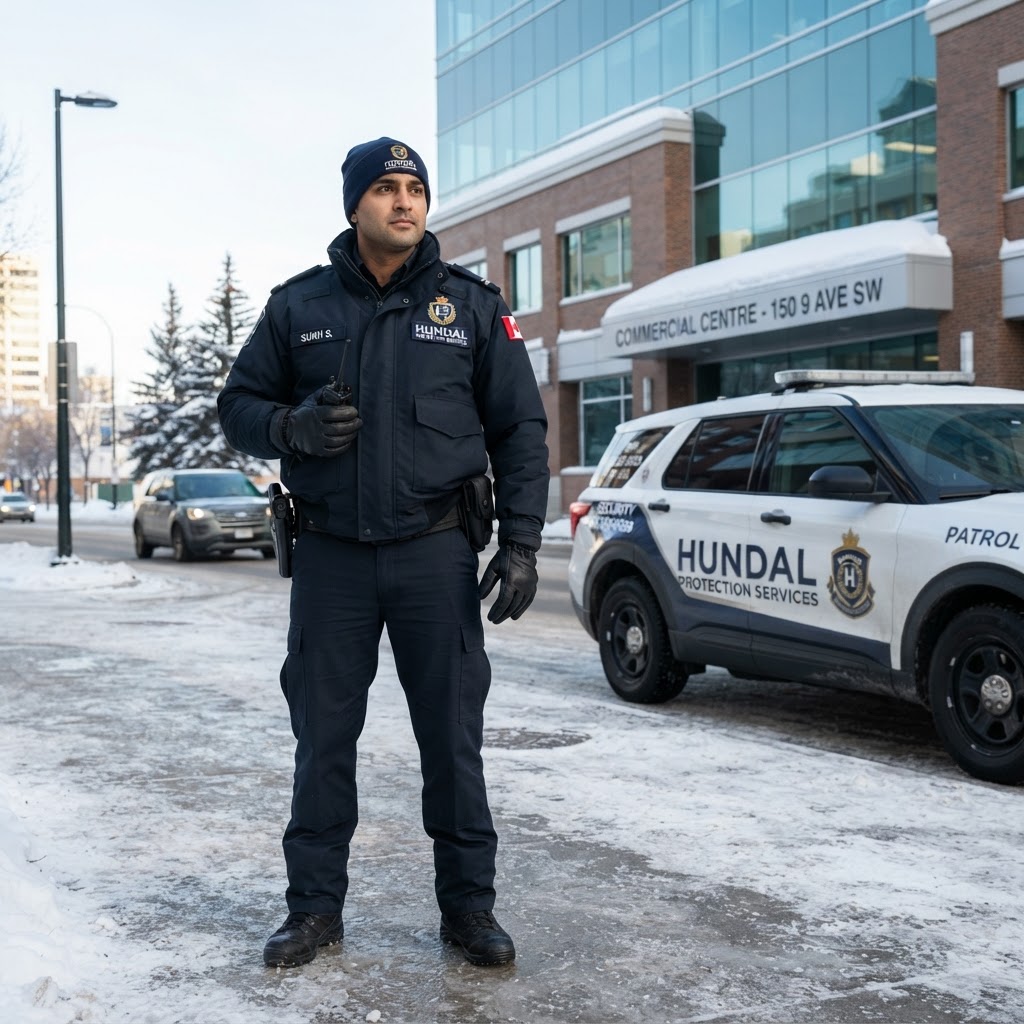
The ground becomes a hazard. Snow, freezing rain and refreeze cycles create slip-and-fall exposure on sidewalks, stairwells, parkades and entryways. It is the biggest winter liability line for property managers, and as much a documentation problem as a clearing one.
Buildings empty out. Holiday shutdowns and reduced staffing leave buildings at partial occupancy. An unmonitored building with no foot traffic is the year's easiest target, and a burst pipe found three days late is a five-figure claim.
What the law expects in BC, Alberta and Ontario
All three provinces impose a duty of reasonable care on anyone who controls premises. The wording differs, but the test is the same: did you inspect, did you respond, and can you prove it?
Ontario amended its Occupiers' Liability Act in 2020 through Bill 118. The amendment added section 6.1, requiring a person injured by snow or ice on private property to give written notice within 60 days before starting a claim. It also protects an independent contractor hired to remove snow or ice from liability unless grossly negligent. Property owners still carry the duty to inspect and document.
British Columbia and Alberta each rely on their own Occupiers' Liability Act with a similar duty of reasonable care. Courts look at whether a sensible inspection and clearing system existed, and whether it was followed on the day of the incident.
Municipal bylaws are where operators get caught, and they are not consistent. Vancouver requires clearing by 10 a.m. the day after a snowfall. Calgary requires it within 24 hours of a snowfall ending, Edmonton allows up to 48 hours, and Toronto generally requires it within 12 hours. Confirm the rule with each municipality, then build your schedule around the tightest deadline that applies to any of your sites.
The winter security checklist
1. Re-time patrols to the actual dark window. A schedule written in June is out of date by November. Rebuild coverage so the highest-risk hours, roughly 4 p.m. to 8 p.m. plus the overnight gap, are covered by presence rather than assumption. For multi-site portfolios, re-sequence mobile patrol routing so the darkest, most isolated sites get the earliest visit.
2. Run documented lock-up checks. Winter lock-ups fail predictably: a door that will not latch in the cold, a dock leveller left raised, a gate chain not re-secured. A guard completing a physical lock-up with a written record catches these, and the record matters as much as the check itself.
3. Keep an ice and snow documentation log. This is the highest-value winter task a guard performs and the one most often skipped. Every patrol should log conditions at each entrance, sidewalk and parkade ramp: time, temperature, what was observed and what was done. If a claim arrives in March, a log showing an inspection at 6 a.m. and salt applied at 6:20 a.m. is the difference between a defensible position and a settlement.
4. Cover parkades and surface lots properly. Parkades concentrate three winter problems: poor lighting, blind corners and vehicle crime. Foot patrols at unpredictable intervals plus presence at ramp entrances reduce theft and the isolated-user complaints that follow tenants into the new year.
5. Build a holiday closure plan per site. For anything closed more than 48 hours, specify interior patrol frequency, water and heating checks, alarm response responsibility, key holder availability, and a named contact who will answer a phone on December 27. Interior patrols also catch the water damage and freeze events exterior monitoring misses.
6. Audit lighting and sight lines after dark. Walk each site at night with the guard who patrols it. Replace failed fixtures, prune overgrowth, confirm that signage about camera coverage is legible. Winter vegetation loss opens new sight lines into a property and new concealment for someone trying to get in.
7. Control entrances and vestibules. Wet floors, tailgating and loitering all concentrate at the front door in winter. Concierge coverage manages access control alongside the physical hazard: saturated mats, drip lines that refreeze overnight, and doors propped for a cigarette break that defeat an entire access control system.
8. Verify contractors and after-hours deliveries. Winter brings snow crews, heating technicians and emergency plumbers onto sites at odd hours. Confirm after-hours access against a schedule rather than on a wave-through. The most common winter access failure is a legitimate contractor letting an unverified person follow them in.
9. Write reports that survive scrutiny. "All secure" is not evidence. "North entrance re-salted 06:20, parkade level 2 light out, door 4 latch sticking, logged for maintenance" is. Specify the reporting standard in the contract and review samples before signing.
Where guards do more than cameras
Cameras are good at telling you what happened and poor at preventing it, and the gap widens in winter. Snow, condensation and low light degrade image quality exactly when coverage matters most. Nobody clears a sidewalk or re-secures a gate because a camera recorded it, and liability defence rests on a record of human inspection, not footage of a fall after it occurred.
Combined camera and guard coverage usually suits high-value sites. For most commercial properties, guards focused on the dark window, documented inspections and holiday closures deliver a more defensible outcome per dollar.
What winter coverage costs
Pricing varies by province, site risk and shift length. As a working range, unarmed static coverage typically bills in the mid-twenties to low-forties per hour, and mobile patrol is usually billed per visit or at a lower rate across multiple sites. Get the reporting standard, escalation path and relief coverage in writing, because those are the parts that fail in February.
FAQ
Do I still need security guards in winter if my building is closed? Yes, often more than in summer. An empty building has no natural surveillance, no staff to notice water damage, and a predictable closure schedule. Interior patrols plus exterior checks are the standard arrangement.
Who is liable if someone slips on ice at my commercial property? The occupier, the party with control of the premises, carries the duty of reasonable care. In Ontario an independent snow removal contractor is protected from claims unless grossly negligent under section 6.1, which does not remove the occupier's own duty to inspect and document.
How often should a guard patrol in winter? There is no single legal number. The defensible standard is a frequency matched to site risk, applied consistently and recorded. High-traffic retail and parkade sites usually need multiple evening passes; a single-tenant industrial site may be well served by scheduled mobile patrol visits.
Can a security guard clear snow and salt walkways? Guards routinely apply salt and grit as a hazard control and log it, and many winter contracts include it at entrances and ramps. Full mechanical clearing is normally a separate service with its own equipment and insurance, so confirm the boundary in writing.
Getting winter coverage in place
The window to act is short. Sites that lock in patrol schedules and inspection routines before the first freeze start the season with a defensible record. The ones that wait spend December catching up.
Hundal Protection Services provides licensed guards, mobile patrol, concierge coverage, vacant property checks and documented hazard reporting across British Columbia, Alberta and Ontario. If you manage a commercial property, retail plaza, industrial yard, strata building or construction site, we can build a winter coverage plan around your hours of darkness and your municipality's clearing deadlines.
Related Security Services


Written by
Hundal Protection Team
Security industry professional at Hundal Protection Services — a licensed multi-province security guard company serving BC, Alberta & Ontario since 2020. Our team holds valid security licences under BC, Alberta and Ontario regulations, carries $5M liability insurance, and maintains a 5.0 Google rating. All content is reviewed for accuracy and compliance with Canadian security industry standards.