K-12 School Security: A Guide for BC, Alberta & Ontario
School Security Guards in Canada: A Practical Guide for K-12 Schools in BC, Alberta and Ontario
School security in Canada looks different from security at a warehouse or a shopping centre. A school is a place where hundreds of children, staff and visitors pass through the same doors every day, and the goal of any security program is not to turn a campus into a fortress. It is to keep the day running normally, with clear control over who is on site and a reliable plan for the rare moments when something goes wrong.
This guide explains what licensed security guards actually do in a Canadian school setting, how the rules differ across British Columbia, Alberta and Ontario, and what administrators should look for when evaluating a provider.
What school security guards do, and what they don't do
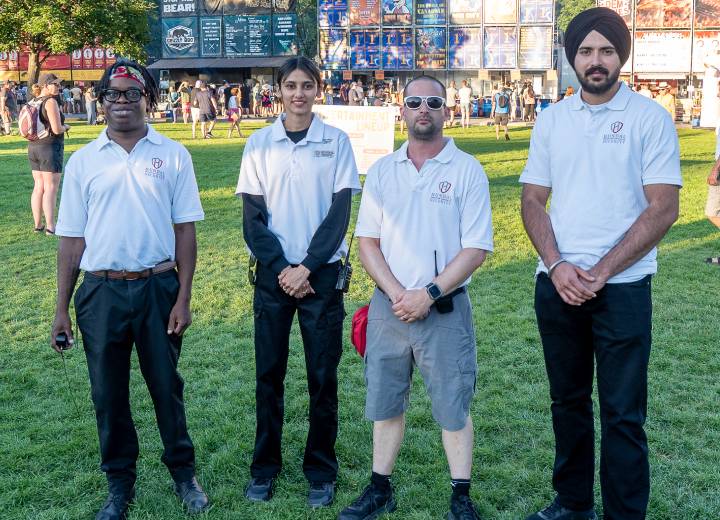
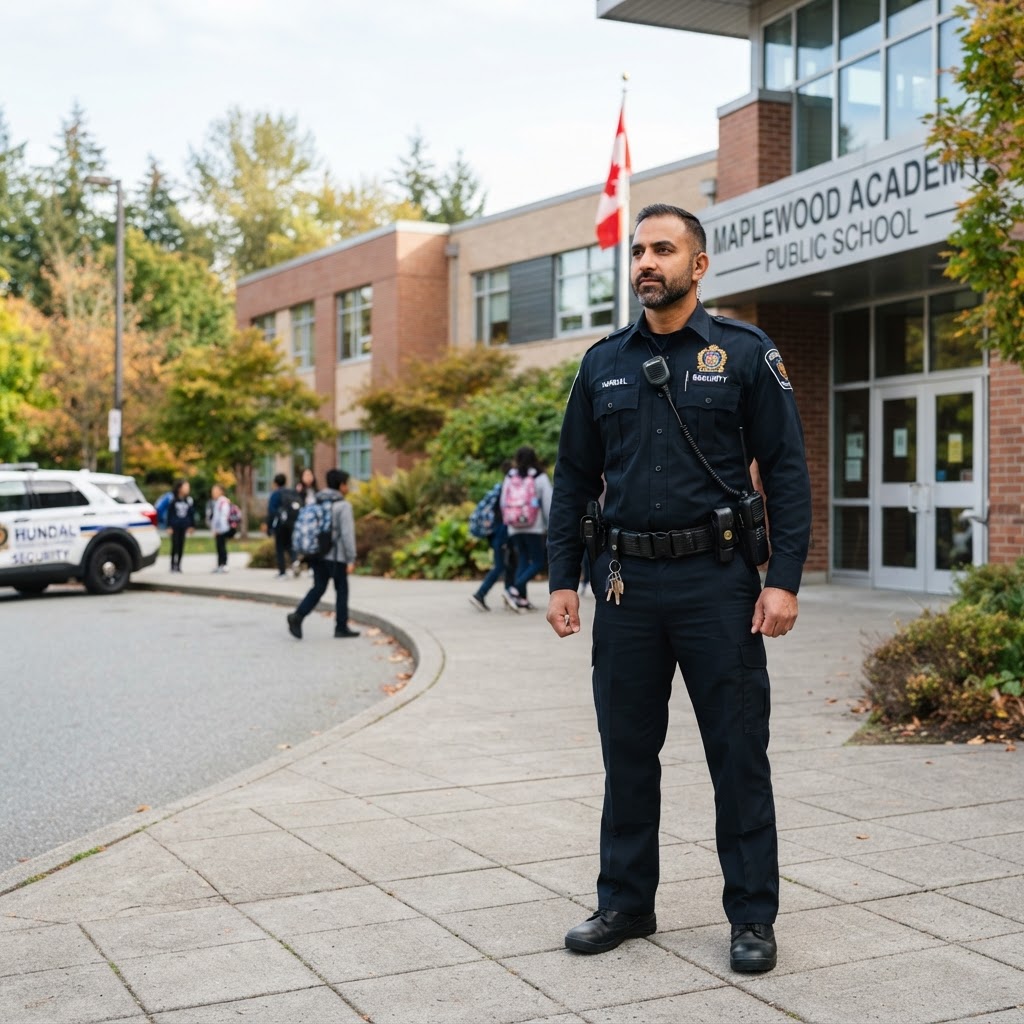
A school security guard is a licensed private professional working under the direction of the school administration. On a typical assignment, the guard's work includes:
- Visitor management at the main entrance: greeting arrivals, confirming appointments, logging visitors, issuing badges and directing people to the office
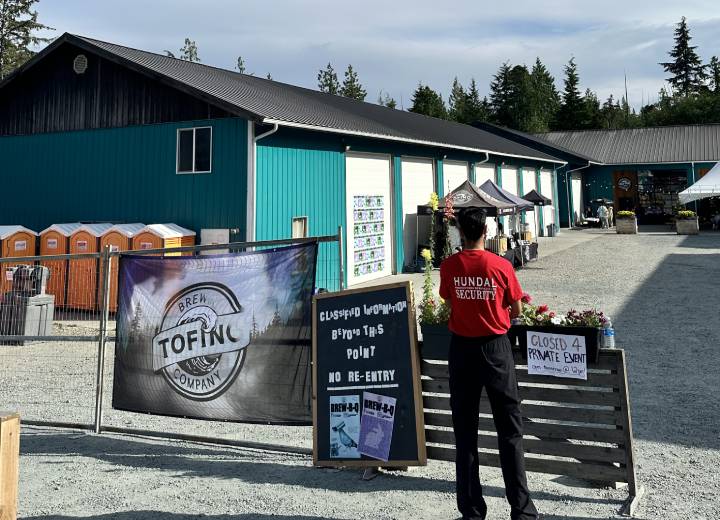
- Access control: checking that exterior doors are secured, confirming that propped or malfunctioning doors are reported and repaired, and monitoring the flow of people during arrival and dismissal
- Visible patrols of hallways, parking areas, portable classrooms, bike racks and perimeter fencing
- Traffic and dismissal support, including crosswalk presence and bus loop supervision where the board assigns it
- De-escalation of disputes between students or between adults on site, using verbal intervention and space rather than physical force
- Incident documentation: factual reports on trespass, vandalism, weapons sightings, medical events or behavioural incidents
- Emergency support: assisting with lockdown, hold-and-secure, fire drill and evacuation procedures under the school's own emergency plan
- After-hours protection for portable classrooms, athletic facilities, equipment storage and construction or renovation areas
What a guard does not do is equally important. Private security guards in Canada are not police officers. They do not investigate crimes, they do not search students, and they do not discipline students. Those are responsibilities of school staff and police. A guard who understands that boundary is an asset. A guard who does not can create liability for the school.
Why schools are hiring guards now
Three pressures have pushed school security onto more board agendas.
Vandalism and after-hours intrusion. Portable classrooms, portables, athletic equipment, copper wiring and HVAC units are recurring targets. A single summer of break-ins can cost more than a year of evening patrol coverage, and insurance deductibles rarely cover the full loss.
Traffic and dismissal safety. Arrival and dismissal are the highest-risk minutes of the school day for injury. Congested kiss-and-go lanes and unsupervised parking lots create daily incidents that a trained adult presence measurably reduces.
Adult behaviour on campus. Custody disputes, aggressive parents, trespass notices and unauthorized adults on school property have become a routine concern for front-office staff who are not trained or positioned to manage them.
Notice what is not on that list: armed intruder response as the sole justification. The strongest school security programs in Canada are built around everyday order and access control, with emergency response as one layer rather than the whole plan.
Licensing rules by province
Security licensing is provincial in Canada, and the requirements differ. Administrators should confirm licensing before anyone steps onto a campus.
British Columbia
Security businesses and individual guards are licensed under the province's security services legislation, administered through the Security Programs Division of the Ministry of Public Safety and Solicitor General. A licensed guard must carry their security worker licence while on duty. Schools should ask for the business licence and the individual licence, not just a business card.
Alberta
Alberta regulates the industry under the Security Services and Investigators Act (SSIA), with licensing handled through Alberta Justice. Both the agency and each guard must hold a valid licence, and guards complete approved training before licensing. Requirements are enforced through inspections and complaints, so a provider with a clean standing is easy to verify.
Ontario
Ontario security guards are licensed by the Ministry of the Solicitor General after completing mandated training and certification. Guards must carry their licence while working. Ontario schools should also confirm the provider's insurance and its willingness to align with the school board's own policies.
The requirement that matters most in a school
Every province requires a criminal record check, but a school setting calls for a vulnerable sector check for anyone with access to children. Many boards also require a recent check, often within the past six months to a year, plus a renewed check on a set cycle. Ask how the provider handles this:
- Are vulnerable sector checks completed before a guard's first shift at a school, or after?
- Who pays for the check, and who keeps the record?
- What happens when a guard's check expires mid-assignment?
- How are relief guards and supervisors screened when they cover a shift?
A provider that answers these questions with a documented process, rather than a promise, is the one to keep talking to.
Building a school security plan that works
A guard without clear instructions is just a person in a vest. The plan matters more than the headcount.
1. Define the post orders in writing. Which doors are opened and when, who is authorized to sign in visitors, what the guard does when a parent without custody arrives, how the guard communicates with the office. Written post orders protect the school, the guard and the students.
2. Separate the roles. The guard manages the door and the perimeter. The office manages student matters. The principal manages decisions. When those lines blur, incidents escalate and staff morale drops.
3. Invest in the physical layer first. Few security measures return more than a functioning door. Door alarms on secondary exits, delayed egress hardware, clear sightlines to the entrance, trimmed landscaping and a single monitored point of entry do more for safety per dollar than almost anything else.
4. Practice the emergency plan together. Guards should participate in the school's lockdown and evacuation drills, not observe them from the parking lot. Familiarity is what turns a plan into a response.
5. Document and review. Written incident reports, a monthly summary and a short review meeting each term let the school adjust coverage to real patterns instead of assumptions.
6. Coordinate with local police. Most Canadian boards operate under a formal police-school protocol. Make sure the security provider knows the protocol, the local detachment's non-emergency number and the escalation triggers.
Coverage models and typical costs
Schools rarely need 24/7 static coverage. The common models are:
| Model | Typical use | Indicative rate | |---|---|---| | Split shift static guard | Arrival, dismissal and lunch supervision | $24 to $34 per hour | | Full school-day static guard | High-incident schools, shared campuses | $24 to $34 per hour | | After-hours mobile patrol | Vandalism prevention, portable and equipment checks | $45 to $85 per visit | | Event and evening coverage | Games, concerts, board meetings, rentals | $28 to $40 per hour | | Summer and holiday patrol | Vacant campus protection | Quoted per schedule |
Rates vary by city, shift length, contract term and whether the site is in a lower mainland, urban or rural market. Short, one-off bookings always cost more per hour than a full-term contract. For a school budgeting a term, a split shift covering roughly four hours a day is often the most cost-effective starting point.
Questions to ask a prospective provider
Before signing, ask directly:
- Can you show me your business licence and the individual licences for the guards assigned to us?
- How and when are vulnerable sector checks completed, and how do you handle relief staff?
- Will you write site-specific post orders after a walkthrough, and can we review them before the first shift?
- What de-escalation and youth-specific training do your guards complete?
- Who supervises the assignment, and how often does a supervisor visit?
- What does your incident report look like, and how fast is it delivered?
- What is your fill rate for shifts, and what happens if a guard calls in sick at 6 a.m.?
- Are you insured, and can you provide a certificate naming the school or board?
A capable provider will answer all eight without hesitation. Vague answers on screening, supervision or shift coverage are the three most common failure points in school contracts.
Frequently asked questions
Do Canadian schools legally need security guards?
No province requires a school to hire security guards. Many boards use them selectively, for high-traffic campuses, shared facilities or persistent after-hours vandalism, alongside locked-door policies and staff supervision.
Can a school security guard search a student's bag?
No. Searching students is a matter for school administration under board policy and, where applicable, police. A guard's role is to observe, report and request support.
Should school guards be armed?
No. Armed security is not appropriate for Canadian K-12 campuses. The work is deterrence, access control, de-escalation and reporting.
How much does a school security guard cost in Canada?
Most school assignments fall between $24 and $34 per hour depending on province, city and shift structure. Mobile patrol for after-hours protection is typically priced per visit rather than per hour.
Is CCTV a substitute for a guard?
CCTV records events and supports investigations, but it cannot greet a visitor, check a door or intervene in a dispute. The strongest programs use cameras to support people, not to replace them.
Final takeaway
Good school security in Canada is quiet, procedural and predictable. It starts with controlled entry, screened and licensed personnel, written post orders and a working relationship with the office and local police. Whether you are in Surrey or Red Deer or Peel Region, the fundamentals are the same, and the provider who can document their screening, supervision and incident reporting is the one worth hiring.
Hundal Protection Services supports schools, campuses and school-adjacent facilities across British Columbia, Alberta and Ontario with licensed guards, after-hours patrols and site-specific security planning.
Related Security Services

Written by
Hundal Protection Team
Security industry professional at Hundal Protection Services — a licensed multi-province security guard company serving BC, Alberta & Ontario since 2020. Our team holds valid security licences under BC, Alberta and Ontario regulations, carries $5M liability insurance, and maintains a 5.0 Google rating. All content is reviewed for accuracy and compliance with Canadian security industry standards.