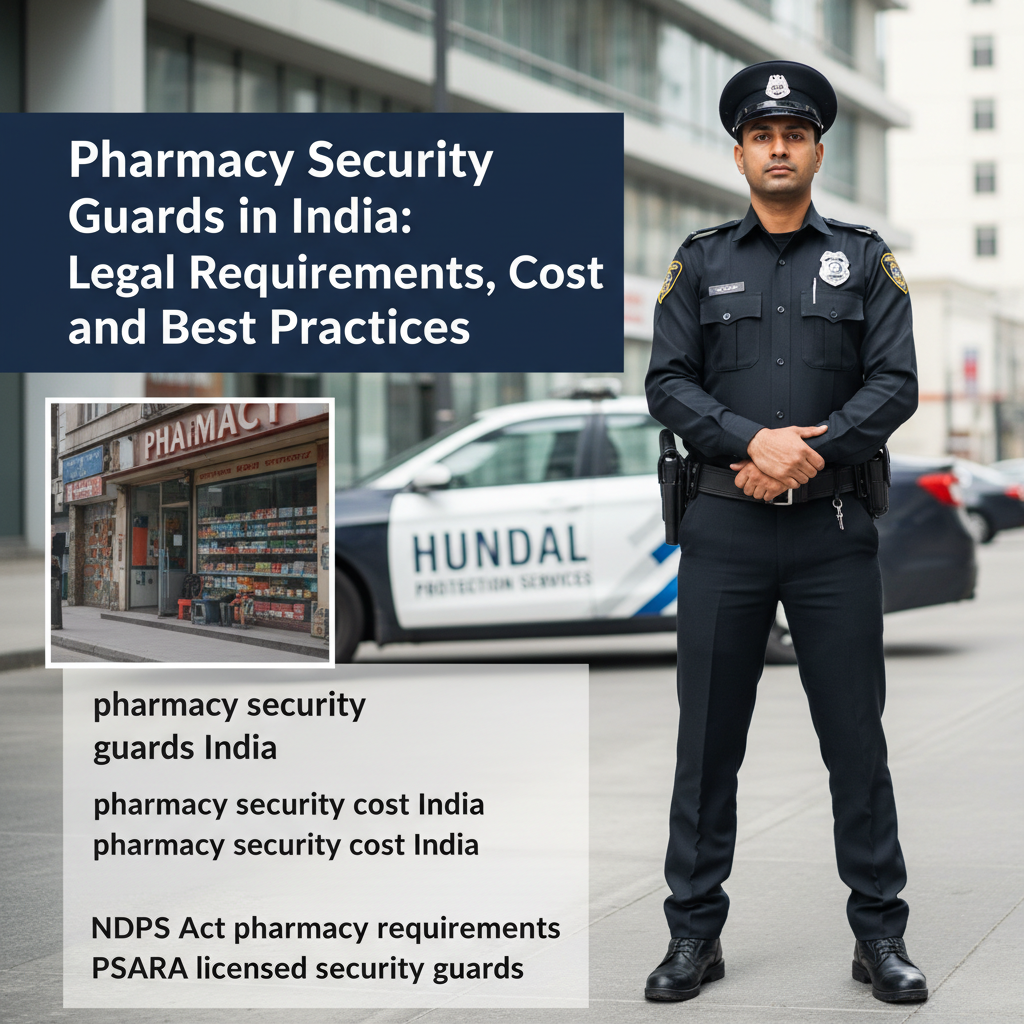
Pharmacy Security Guards: Costs & Best Practices
Pharmacy Security Guards in India: Legal Requirements, Cost, and Best Practices 2026
Indian pharmacies lose ₹9-18 lakh annually to theft, making professional security an essential investment rather than an optional expense. Whether you operate a standalone chemist shop in Delhi, a hospital pharmacy in Mumbai, or a chain outlet in Bangalore, understanding the legal framework and cost structure of pharmacy security can protect your business, your staff, and your controlled substance inventory.
This guide covers everything pharmacy owners and managers need to know about hiring security guards in India — from NDPS Act compliance and PSARA licensing to guard costs, ROI calculations, and city-wise standards.
Why Pharmacies Are High-Risk Retail Environments
Pharmacies face a unique combination of security threats that most retail businesses do not:
- Controlled substance theft: Opioids, benzodiazepines, and Schedule H/X drugs are prime targets for internal and external theft.
- Cash handling exposure: High-volume cash transactions create robbery risk, especially during evening hours.
- Prescription fraud: Forged or altered prescriptions leading to unauthorized drug dispensing.
- Staff safety: Pharmacists and technicians face verbal and physical aggression from customers seeking controlled medications.
- Shrinkage from shoplifting: OTC products, baby formula, and personal care items are frequently shoplifted.
A trained security guard addresses all five of these risk categories simultaneously — something CCTV cameras and alarm systems alone cannot achieve.
Legal Framework: NDPS Act & PSARA Licensing
The Narcotic Drugs and Psychotropic Substances (NDPS) Act, 1985
The NDPS Act governs the sale, storage, and distribution of narcotic and psychotropic substances in India. For pharmacies, this creates direct security obligations:
- Schedule H and H1 drugs must be stored in locked cabinets with restricted access.
- Schedule X drugs require additional recordkeeping and storage protocols.
- Pharmacies found negligent in preventing theft of controlled substances can face license suspension and criminal liability under Sections 15–25 of the NDPS Act.
While the NDPS Act does not explicitly mandate security guards, it creates a de facto requirement: if your pharmacy cannot demonstrate reasonable security measures, you are exposed to regulatory action following any theft incident.
PSARA Licensing (Private Security Agencies Regulation Act, 2005)
Any security agency providing guards to your pharmacy must be licensed under PSARA. Key requirements include:
- State-level licensing: Each state issues its own PSARA license; a Delhi-licensed agency cannot legally deploy guards in Maharashtra without a Maharashtra PSARA license.
- Guard training certificates: All deployed guards must have completed a minimum 100-hour training program approved by the Controlling Authority.
- Background verification: PSARA-licensed agencies are required to conduct police verification for all guards.
- Uniform and ID requirements: Guards must wear uniforms and carry valid identity cards at all times.
What this means for pharmacy owners: Always request a copy of the agency's PSARA license and individual guard training certificates before signing a contract. Non-compliant agencies expose you to legal liability.
Guard Costs by City (2025–2026 Rates)
Security guard costs in India vary significantly by city, guard classification, and shift structure.
Monthly Cost Ranges
| City | Unarmed Guard (per month) | Armed Guard (per month) | |------|--------------------------|-------------------------| | Delhi/NCR | ₹18,000 – ₹28,000 | ₹32,000 – ₹52,000 | | Mumbai | ₹22,000 – ₹35,000 | ₹38,000 – ₹60,000 | | Bangalore | ₹20,000 – ₹32,000 | ₹35,000 – ₹55,000 | | Pune | ₹18,000 – ₹28,000 | ₹30,000 – ₹48,000 | | Hyderabad | ₹17,000 – ₹26,000 | ₹28,000 – ₹45,000 | | Chennai | ₹17,000 – ₹27,000 | ₹29,000 – ₹46,000 |
Note: Rates above reflect 2025–2026 market rates including ESI, PF, and statutory compliance costs passed through by agencies. Direct employment costs may differ.
Armed vs. Unarmed Guards for Pharmacies
Most standalone pharmacies and hospital outpatient pharmacies are adequately served by unarmed guards. Armed guards are typically recommended for:
- Pharmacies operating in high-crime areas
- Locations with a history of robbery
- 24-hour pharmacies in isolated areas
- Pharmacies storing large quantities of Schedule X medications
For most urban chain pharmacies, a well-trained unarmed guard with visible presence and CCTV monitoring is the most cost-effective configuration.
ROI Calculation: Is a Security Guard Worth It?
Let's model a mid-sized pharmacy in Bangalore with ₹15 lakh in annual losses from theft, shrinkage, and prescription fraud:
Annual Cost of One Unarmed Guard (Bangalore)
- Monthly cost: ₹26,000
- Annual cost: ₹3,12,000
- Statutory compliance (if not included): ₹0 (assume agency handles)
Annual Loss Reduction (Conservative Estimate)
- Theft deterrence: 60–75% reduction in shrinkage = ₹9–11 lakh saved
- Prescription fraud reduction: ₹1–2 lakh saved
- Staff safety incidents avoided: ₹0.5–1 lakh in incident costs avoided
Net ROI: ₹10.5 – ₹14 lakh saved on ₹3.12 lakh investment = 237%–349% ROI
Even at the low end, the financial case for pharmacy security is overwhelming. This does not account for insurance premium reductions, reduced staff turnover from improved workplace safety, or regulatory penalty avoidance.
City-Wise Security Standards
Delhi & NCR
Delhi pharmacies operate under Delhi Police jurisdiction for crime reporting and face some of India's highest rates of pharmaceutical theft. The Delhi PSARA Controlling Authority enforces licensing strictly. Key considerations:
- 24-hour pharmacies in South Delhi and Connaught Place face elevated robbery risk.
- Guard deployment during 9 PM – 6 AM is strongly recommended for standalone outlets.
- NCR pharmacies (Gurgaon, Noida, Faridabad) fall under Haryana and UP PSARA licensing respectively — ensure your agency holds multi-state licenses if operating across NCR.
Mumbai
Mumbai's density creates unique security challenges. High foot traffic in areas like Dadar, Andheri, and Bandra increases both shoplifting risk and the difficulty of monitoring the sales floor.
- Hospital pharmacies at KEM, Hinduja, and Lilavati should consider dual-guard deployment during peak hours.
- Agencies must hold Maharashtra PSARA licensing.
- Mumbai minimum wage for security guards is among the highest in India, reflected in the cost table above.
Bangalore
Bangalore's tech corridor pharmacies serving corporate campuses often face lower street crime but higher internal theft risk due to volume of prescription processing.
- HSR Layout, Whitefield, and Electronic City pharmacies benefit from guards trained in access control for staff-only dispensary areas.
- Karnataka PSARA license required.
Pune
Pune's growing pharmaceutical manufacturing and retail sector has seen increased theft targeting high-value medications. Shivajinagar and Kothrud areas report above-average pharmacy theft rates.
- Maharashtra PSARA license covers both Mumbai and Pune deployments.
- Consider Mobile Patrol services for pharmacy chains operating multiple outlets across Pune, as rotating patrol visits can supplement static guard posts cost-effectively.
Best Practices for Pharmacy Security Guard Deployment
1. Position Matters
A guard stationed at the entrance provides maximum deterrence value. Guards positioned behind the counter or in back rooms provide minimal visible deterrence — the primary driver of theft reduction.
2. Define Clear Protocols
Provide your security agency with written Standard Operating Procedures (SOPs) covering:
- Who can access the dispensary/controlled substance storage area
- How to handle aggressive or intoxicated customers
- When to call police vs. handle internally
- Incident reporting format and escalation chain
3. CCTV Integration
Guards are most effective when paired with CCTV coverage. Ensure your guard is briefed on camera blind spots and is positioned to cover areas the cameras cannot.
4. Shift Overlap
Shift changes are the highest-risk period for theft — both external and internal. Require a 15-minute overlap between outgoing and incoming guards during which inventory of key items is verbally confirmed.
5. Regular Agency Audits
Every 6 months, request updated guard training records, refreshed background checks, and a review of the deployment roster. Guard turnover at agencies can be high; ensure the individuals assigned to your pharmacy are current and qualified.
Choosing the Right Security Agency
When evaluating security agencies for your pharmacy, prioritize:
- Valid PSARA license for your specific state
- Pharmacy or retail experience — ask for client references in the pharmaceutical sector
- Transparent pricing that clearly breaks out agency fee, guard wages, ESI/PF, and any additional charges
- Incident reporting systems — digital logs accessible to pharmacy management
- Rapid replacement guarantees — contractual commitment to replace absent or underperforming guards within 4–8 hours
For pharmacy chains operating across multiple cities, consider agencies with national or multi-state PSARA coverage to maintain consistent standards. You may also benefit from combining static guard posts with Event Security support for high-traffic promotional events or health camp days at your pharmacy locations.
For tailored security planning across your pharmacy locations, Contact Hundal Protection to discuss a customized deployment strategy.
Frequently Asked Questions
Is it legally required to have a security guard at a pharmacy in India? There is no single law that explicitly mandates security guards at all pharmacies in India. However, the NDPS Act creates strong implied obligations for pharmacies storing Schedule H, H1, and X drugs to implement reasonable security measures. In practice, state drug licensing authorities increasingly expect evidence of security protocols during inspections, and negligence in securing controlled substances can result in license suspension.
What qualifications should a pharmacy security guard have? A PSARA-compliant guard should have completed a minimum 100-hour training program covering access control, conflict de-escalation, emergency response, and report writing. For pharmacies specifically, look for guards with retail security experience and, ideally, training in handling customers who are aggressive or under the influence. Background verification through police clearance is mandatory under PSARA and should be verified before deployment.
How many security guards does a pharmacy need? Most standalone pharmacies with a single entrance and moderate foot traffic operate effectively with one guard per shift. High-volume hospital pharmacies, 24-hour outlets, or multi-entrance locations may require two guards during peak hours. A security consultant can conduct a site assessment to recommend the right staffing level based on your floor plan, operating hours, and historical incident data.
Can a pharmacy in Delhi use a security agency licensed only in Maharashtra? No. PSARA licensing is state-specific, and a Maharashtra-licensed agency cannot legally deploy guards in Delhi without obtaining a separate Delhi PSARA license. If you operate pharmacy locations across multiple states, ensure your security agency holds valid licenses in every state where you operate, or engage separate agencies per state.
What is the difference between static guard and mobile patrol for a pharmacy? A static guard is assigned to one location full-time, providing continuous on-site presence. A mobile patrol involves a guard or patrol vehicle visiting multiple locations on a scheduled or random rotation. For single-location pharmacies, static guards provide better deterrence. For pharmacy chains with several outlets in proximity, a hybrid model — static guard at the highest-risk location plus mobile patrol covering others — can significantly reduce overall security costs without sacrificing coverage.


Written by
Hundal Protection Team
Security industry professional at Hundal Protection Services — a licensed multi-province security guard company serving BC, Alberta & Ontario since 2020. Our team holds valid security licences under BC, Alberta and Ontario regulations, carries $5M liability insurance, and maintains a 5.0 Google rating. All content is reviewed for accuracy and compliance with Canadian security industry standards.